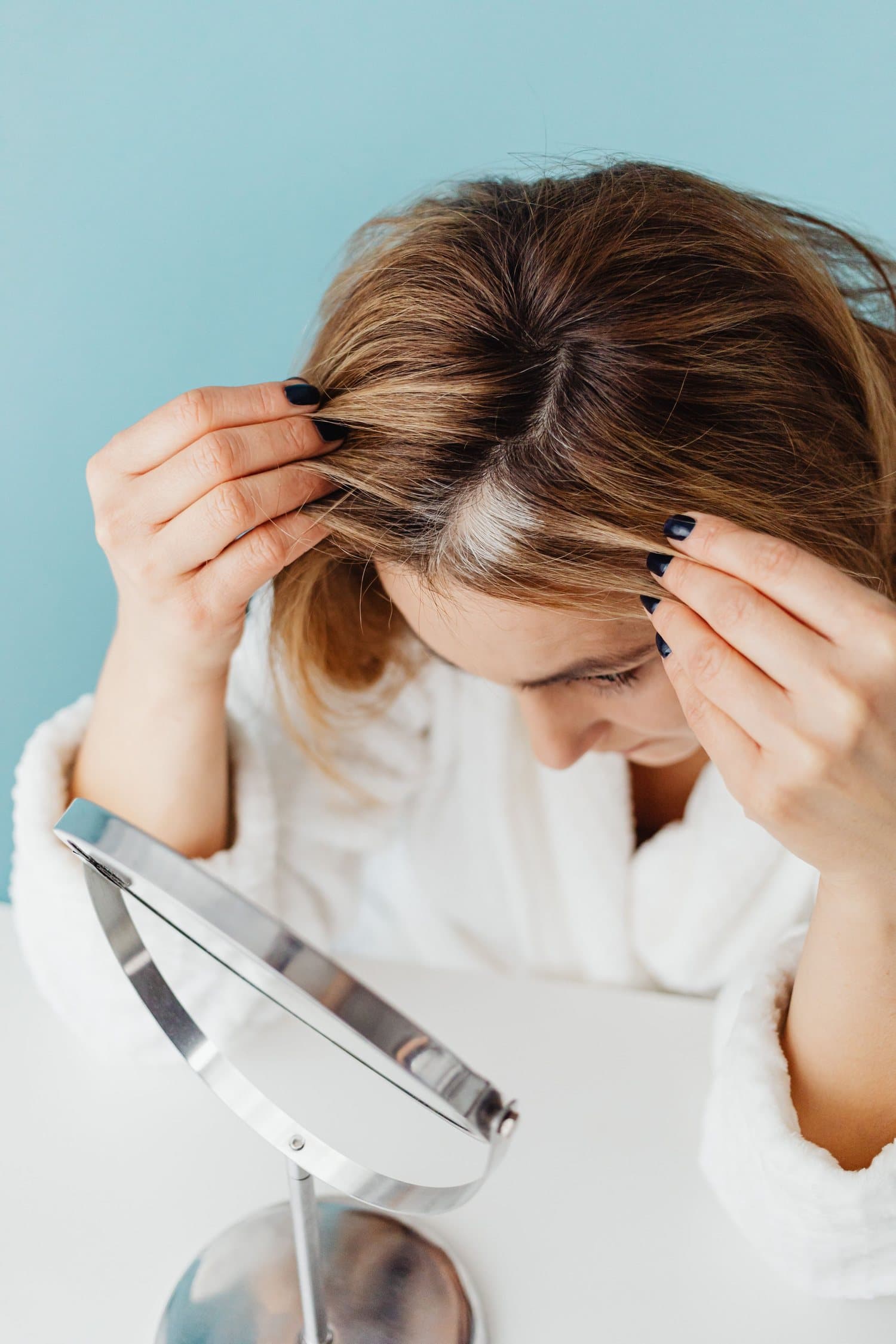
Pattern loss or shedding
Is this pattern hair loss or shedding?
The most common hair loss in women falls into one of two groups, and they look different if you know what to look for.
Pattern hair loss
This is slow. You probably can't say when it started. The parting gets wider over a year or more, the crown looks thinner under bright lights, but your front hairline mostly stays where it was. The hairs themselves get finer and shorter, so it can feel like you have less hair even when you're not losing much in the brush. It runs in families, though not always in an obvious way, and it becomes more common after 40 as hormones shift. Doctors call it female pattern hair loss or androgenetic alopecia.
Shedding
This is fast, and it's frightening. Handfuls in the shower. Hair on the pillow. It comes from all over your head rather than one area, and it usually starts two to four months after something happened to your body - an illness with a fever, having a baby, a crash diet, a big shock or stressful period, a general anaesthetic, rapid weight loss, or starting or stopping a medicine. The gap is the giveaway. Hair that was pushed into its resting phase back then is only falling out now. Specialists call this telogen effluvium. It often settles by itself within about six months, and the density comes back over the year after that.
Some women have both at once - a shed that unmasks pattern thinning that was quietly there underneath. That is exactly why guessing gets people the wrong treatment. If you want the full picture on shedding, including what to do while you wait for it to stop, read our guide on hair shedding. If you want to know which one is happening to you, the Milton Keynes Hair Loss Clinic assessment will tell you in 2 minutes.
What it means
Is this a sign of something serious?
It's the question on many people's lips. Most female hair loss is either pattern hair loss or shedding. Neither is dangerous. Neither means anything is wrong with the rest of you. They are common, they are treatable or self-limiting, and they are not a warning sign.
A smaller group of women are losing hair because of low iron stores or an underactive thyroid. It's worth finding this out, because the hair won't fully recover until they're fixed, and low iron and thyroid problems affect a lot more than hair. Both show up on a blood test, which your GP can arrange, and both are usually straightforward to treat.
A very small number of women have a type of hair loss that needs a specialist. These have particular signs, which we describe later.
Am I going to go bald?
Almost certainly not. When women imagine hair loss they picture what happens to men - a receding hairline, a bald crown, eventually a shiny top. Female pattern hair loss doesn't do that. It thins. The parting widens and the hair gets finer, but the follicles rarely stop producing hair altogether, and complete baldness in women is very rare.

It is progressive if you leave it alone, which is the honest argument for acting rather than waiting. But the picture in your head is almost certainly worse than what is actually going to happen.
Find the cause first
Why the cause matters
Imagine two women in Milton Keynes with the same widening parting. One has pattern hair loss. The other has been shedding for four months because her iron stores are low after years of heavy periods. If both start minoxidil, the first is likely to see her hair thicken over the next year. The second will see very little, because minoxidil can't fix a shortage of iron, and she'll think nothing works.
That's why we don't start with treatment. We start with the cause. For a lot of women the answer is clear from a few careful questions. For others, the next step is a blood test, which is cheap, quick, and changes the plan for a meaningful minority. Two things matter most - ferritin, which measures your iron stores rather than just your blood count, and thyroid function. Vitamin D is often checked alongside them.
And for a few women, the right first step is a doctor rather than a pharmacy. Knowing which group you're in is the whole point.
If your GP said your bloods were normal
A lot of women reading this have already been to their GP about their hair. They had a blood test, they were told everything was fine, and they were sent away with a suggestion that it was probably stress. Nothing changed, and they were left feeling they'd imagined the whole thing.
But here is what "normal" actually means. Every blood test has a reference range, and a result anywhere inside it is reported as normal. For ferritin, that range starts very low, because it was set to answer the question "has this person run out of iron?" It was not set to answer "is there enough iron here to grow hair well?" Many hair specialists want to see ferritin comfortably above the bottom of the range before they'd rule iron out as a factor.
This is why, if the assessment suggests a blood test is relevant, it asks you for the actual number rather than whether you were told it was fine. Your GP wasn't wrong. They were answering a different question. If you have a recent result, dig it out before you start.
Common triggers
The things that trigger hair loss in women
Here are the most common causes, so you can spot yourself quickly. The assessment asks about all of them.
After having a baby
During pregnancy, high hormone levels hold hair in its growing phase, which is why so many women say their hair was never better. A few months after the birth, all that held-back hair lets go at once. It's alarming, it's normal, and it usually peaks around three to four months and settles by the baby's first birthday. If you're a year on and your parting is still widening, that's the point to look further, because pregnancy shedding can also unmask pattern hair loss. If you're pregnant or breastfeeding now, we won't offer treatment, and we'll explain why.
Perimenopause and menopause
As oestrogen falls, the balance tips towards the androgen hormones that drive pattern hair loss, and thinning that was quietly there for years can suddenly become visible. This is the single most common time for women to first notice it. HRT can help many symptoms of menopause, but it is not a hair loss treatment in itself, and plenty of women on HRT still need something for their hair. If you're in your forties or fifties and your parting has changed in the last couple of years, this is very likely part of the story.
PCOS and hormonal causes
Polycystic ovary syndrome raises androgen levels, and in some women that shows up as thinning at the crown and parting, often alongside irregular periods, acne, or extra hair on the face or body. The hair loss itself is treated in the same way as pattern hair loss, but PCOS deserves its own conversation with your Milton Keynes GP, because it affects far more than hair. If you recognise the other signs and haven't had them looked at, do that too.
Hormonal contraception
Starting, stopping or switching hormonal contraception can trigger a shed a few months later. It usually settles. Less well known is that some progestogens are more androgenic than others, and for women who are prone to pattern hair loss, a particular pill or coil can nudge it along. That isn't a reason to stop contraception, but it is worth raising with your Milton Keynes GP surgery or sexual health clinic, because there are options with a lighter androgenic profile that are more hair-friendly.
Iron and thyroid
Heavy periods, a vegetarian or vegan diet, or a known thyroid condition all make low iron or thyroid problems more likely, and both are common, correctable causes of hair loss that don't respond to hair treatment alone. If any of these apply to you, a blood test is the smart first step, and the assessment will say so.
Tight hairstyles, braids and extensions
Years of tight ponytails, braids, weaves, extensions or tightly pulled-back styles can gradually pull hair out at the roots, especially along the front hairline and temples. This is traction alopecia. Caught early it's usually reversible, and the treatment is changing the style, not taking a tablet. Left for years, the follicles can scar and the loss becomes permanent. If your hairline has crept back and you've worn tight styles for a long time, loosen them now, whatever else you decide.
Weight loss injections and rapid weight loss
Losing weight quickly, whether through diet, surgery or medicines like Mounjaro or Wegovy, is one of the most common shedding triggers we see right now. It's thought to be the weight loss and the drop in nutrients that cause it, not the medicine directly, and it almost always settles once your weight stabilises and any deficiencies are addressed.
When to see a doctor
When hair loss needs a doctor, not a pharmacy
Some kinds of hair loss should be seen by a GP first, and in some cases by a dermatologist, before anyone talks about hair loss treatments. We don't treat these, and we'll tell you if the assessment suggests one of them. Here are the signs to know:
- Your hairline is receding at the front or sides and your eyebrows are thinning or disappearing at the same time, which in women, particularly over 40, can be a condition called frontal fibrosing alopecia that needs a dermatologist early because hair lost to it doesn't come back.
- Smooth, round, completely bald patches, which can be alopecia areata.
- A scalp that is sore, itchy, scaly, blistered or looks scarred.
- Hair loss alongside other symptoms such as unusual tiredness, unexplained weight change or irregular periods.
Patchy loss, a sore or inflamed scalp, or hairline and eyebrow thinning in women should be seen by a GP first. If the assessment picks up any of these, it won't offer you treatment. It will give you a short, clear list of what to say and what to ask when you book the appointment, so you're not starting from nothing.
Learn more about scalp treatment and conditions.
Not sure your hair loss fits either pattern, or want your scalp checked in person before starting treatment? A registered Milton Keynes trichologist can see you face to face. We've set out what they do, what it typically costs and when a visit is worth it.
You've already spent money on things that didn't work
Biotin. Rosemary oil. Collagen. Caffeine shampoo. A scalp massager. Hair gummies that taste like sweets. If some of these are in your bathroom cabinet, you're not alone. It's what gets sold to women who type "thinning hair" into their phone at midnight.
None of it is dangerous. But none of it moves the needle either. Biotin only helps if you're deficient in it, which almost nobody eating a normal diet is. Collagen is digested like any other protein. Shampoo washes off - it can make hair look fuller for a day, but it cannot reach the follicle where hair is actually made. Iron tablets help if your iron is low and do nothing if it isn't, and taking them when you don't need them can cause harm, which is why we'd rather you tested first.
We don't sell any of it, and we won't suggest you buy it. At Milton Keynes Hair Loss Clinic, we only recommend what the evidence actually supports.
Explore your treatment options
Female hair loss treatment in Milton Keynes
Once pattern hair loss is confirmed, the treatment with the strongest evidence in women is minoxidil, and it comes in two forms.
Topical minoxidil - the licensed first-line option
Minoxidil foam or solution, applied to the scalp, is licensed for female pattern hair loss and is available from most pharmacies in Milton Keynes without a prescription. It works for a good proportion of women who stick with it. The main issue is the sticking with it. It has to go on the scalp every day, it can leave hair greasy or stiff, it's hard to apply through long or thick hair, and it can irritate the skin. Many women who start it have stopped within a year, and when you stop, the benefit goes.
Low dose oral minoxidil - another option
This is the same ingredient, taken as a small once-daily tablet. Minoxidil was originally licensed as a blood pressure medicine at much higher doses. At the low doses used for hair, it's what's called off-label - it's not licensed for hair loss on the packet, but is widely prescribed for it by dermatologists and hair specialists because the evidence has grown and because women actually take it. There's no foam, no greasy scalp, nothing to work into your hair. A clinician will check it's right for you before it's prescribed.
It isn't right for everyone. It's not prescribed if you're pregnant, breastfeeding or planning a pregnancy, or if you have certain heart or blood pressure conditions, and the full consultation will ask about all of this. The side effects worth knowing about are that some women notice fine extra hair on the face or arms, which is dose-related and fades if the dose is reduced or the tablet is stopped. Some women get mild ankle swelling or feel light-headed on standing, and some see a temporary increase in shedding in the first couple of months, which is the treatment working, not failing. Read the full minoxidil for women page for how it's prescribed.
What we don't do
We don't offer PRP injections, laser caps, 'hair growth serums', supplements or scalp treatments, because the evidence for them in women is thin (and the prices are not!). We aren't a dermatology service, so we don't diagnose or treat scarring or autoimmune hair loss. And we don't do hair transplants. For most women with pattern thinning, a transplant isn't the right first step anyway - when the thinning is spread across the whole top of the head, there's rarely a strong enough donor area at the back to take hair from, and the underlying loss carries on around the transplanted hairs.
How it works
Our Milton Keynes female hair loss clinic
We're an online clinic, so there's no waiting room in Milton Keynes to sit in. Where a scalp needs to be seen in person, we'll say so, and point you to someone who can help.
Free assessment
Take the 2-minute assessment. It asks what you've noticed, when it started, and the things that matter for women specifically - periods, pregnancy, contraception, thyroid and hairstyles. At the end, you get the most likely cause and one clear next step.
Today
The right next step
If the assessment points to pattern hair loss, you'll be referred to our pharmacy partner, The Independent Pharmacy, to complete a full online consultation. A prescribing clinician reviews your answers and checks treatment is right for you.
This week
A short-lived shed
The timings from here are counted from the day you start treatment. Shedding may get worse before it gets better. Treatment pushes out resting hairs to make way for new growth, which can feel like the opposite of what you signed up for. If it happens, it's temporary and normal.
Months 1 to 2, if prescribed
Less in the brush
You should see less hair in the brush and the plughole. You may not see a difference in the mirror yet, but the shedding has slowed.
Months 3 to 4
Compare your photos
This is when changes in density become visible. Compare photos rather than trusting a mirror under bathroom lights. Most women who respond see a difference in their parting within this window.
Months 6 to 12
Keep what you've gained
Treatment holds the result while you take it. If you stop, your hair gradually returns to where it would have been without treatment, over six to twelve months. That's true of every hair loss treatment that works, and it's better to know now than at month four. At Milton Keynes Hair Loss Clinic, we suggest taking a parting photo every three months.
Ongoing
Track it properly
Take this photo today
Thinning is too gradual to judge in the mirror. A photo from today next to one in three months is the only reliable way to tell whether your hair has stayed the same, your parting has widened, or your shedding has started to grow back. This works for you if you're:
Take two photos now - one looking down on your usual parting, and one of your ponytail pulled over your shoulder, so you can see how thick it is. Same light, same parting, same phone position each time, just after washing and drying.
We'll remind you when it's time
We'll email you a reminder at 3, 6 and 12 months to take the same two photos again and compare them. If you can see a change, we'll tell you what it usually means and what to do next.
Milton Keynes female hair loss FAQs
It's the same underlying process, driven by hormones acting on genetically sensitive follicles, but it looks different. Men recede and go bald at the crown. Women keep their hairline, thin across the parting and top, and very rarely go bald. The treatments overlap for minoxidil, but finasteride, the usual first choice for men, isn't used in women of childbearing age.
Shedding reverses on its own once the trigger has passed. Pattern hair loss can be improved and then held with treatment, and many women get back a noticeably fuller parting, but it's managed rather than cured. If you stop treatment, the thinning slowly returns. Traction alopecia reverses if caught early. Scarring types don't, which is why they need to be seen quickly.
Almost always, yes. Shedding stops within about six months of the trigger, and density often comes back over the following six to twelve months. If it's been more than a year and your parting is still widening, something else is likely going on, and that's when to reassess.
Not everyone does. If your history suggests pattern hair loss and nothing points to low iron or thyroid issues, you can go straight to a consultation. If your hair loss looks like shedding, whether it's recent or has gone on for months alongside heavy periods, a vegetarian or vegan diet or a thyroid condition, the assessment will suggest a blood test first. Low iron or a thyroid problem can keep a shed going, and no hair treatment will fix that.
If you want to keep the result, yes. Treatment holds pattern hair loss in check while you're taking it. That's true of every hair loss treatment that works, topical or tablet, and it's better to decide with that in mind.
Oral minoxidil isn't prescribed if you're pregnant or breastfeeding. If you're planning to get pregnant, the assessment will flag this and the clinician will talk it through with you.
The pill can trigger a temporary shed when you start, stop or switch, and some progestogens are more androgenic than others, which can nudge along pattern hair loss in women who are prone to it. It's worth raising with your GP or sexual health clinic if you've noticed a change since a switch.
Sometimes a little, but it isn't a hair loss treatment and shouldn't be started for that reason. Many women on HRT still need minoxidil for their hair. If you're already on HRT and your hair is still thinning, that's a normal reason to be assessed.
Pattern hair loss runs in families on both sides, so she's more likely to than someone with no family history, but it isn't certain, and it tends to be milder and later in women. If she does, knowing early is an advantage - treatment works best when there's more to protect.
Typically, you can expect less shedding by month three or four, and visible change in the parting by six to twelve months. Judge it by photos, not the mirror.
Most women don't. You should if you have patchy loss, a sore or inflamed scalp, or a receding hairline with thinning eyebrows, or if your hair loss doesn't fit the usual patterns. Your GP can refer you, and the assessment will tell you if that's the right route.
About the author

Kate Holohan
RIT · Cert Ed · Registered Trichologist
Kate Holohan is a registered trichologist and the founder of Hair Therapy UK, an award-winning trichology clinic in Kings Hill, Kent. She has worked with hair and scalps for more than 30 years, first in hairdressing and education. She then trained in trichology with the Institute of Trichologists.
Kate diagnoses and treats hair loss and scalp conditions in adults and children. Her work covers female pattern thinning, shedding, alopecia, hair loss linked to hormones, menopause, thyroid and medication, and scalp conditions such as psoriasis and seborrhoeic dermatitis. She also supports people with medical hair loss from cancer treatment and surgery. She hosts the Hair Therapy podcast, which has more than 200 episodes on hair health and real patient stories. Kate has spoken at the World Trichology Conference.
Her approach starts with a careful consultation to understand what is driving the hair loss before recommending a plan. She works with a wide referral network that includes dermatologists, prescribers and blood-testing services, so people get to the right specialist.
- Professional registration
- RIT (Institute of Trichologists, Registrant)
Medically reviewed
This page was last medically reviewed by Kate Holohan on .

Kate Holohan
RIT · Cert Ed · Registered Trichologist
Milton Keynes Hair Loss Clinic is committed to providing clear, accurate and evidence-based information about hair loss, hair thinning, scalp conditions and their treatment.
Our content is reviewed at least every 12 months to reflect current UK clinical guidance. All treatment pathways described on this website are subject to individual clinical assessment and review.
Read our editorial policy to see how our content is written, reviewed and kept up to date.
